What is laser cleaning?
A practical guide to understanding how industrial laser cleaning works, what it can remove and how to choose the right machine for your applications in Spain.
Suitable for workshops, contractors, maintenance teams and industrial users.
Local presence in Costa Blanca (Alicante / Valencia)
LaserSan operates with local teams and equipment in the Costa Blanca region, supporting industrial laser cleaning projects across Alicante, Valencia and surrounding areas, with onsite demos and test cleaning.
Industrial laser cleaning — a practical overview
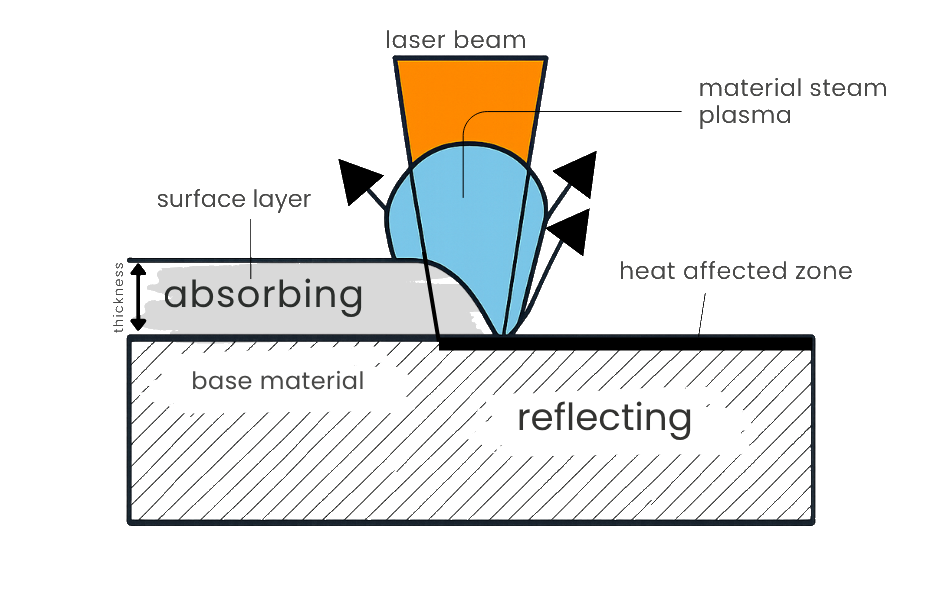
Industrial laser cleaning uses short, controlled laser pulses to remove rust, paint, oxides, coatings and surface contaminants without abrasive blasting or chemicals. The laser energy is absorbed by the contamination, causing it to detach from the base material through micro‑vibration and thermal expansion.
The process is non‑contact, highly selective and produces minimal secondary waste — making it suitable for metal workshops, manufacturing plants, maintenance contractors and restoration work.
Materials we work with
Metal (steel, aluminium, stainless steel), wood, plastics, composites, rubber, stone and coated surfaces.
- Selective removal — targets the coating layer only, protects the base metal.
- No abrasive impact — no sand, blasting media or chemicals required.
- Controlled & repeatable — for rust, paint, weld cleaning and coating prep.
What we clean every day
- Rust removal — metal structures, machinery parts, pipes, beams
- Paint and coating removal — industrial surfaces, machinery, vehicles, facades
- Welding prep & post‑weld cleaning — oxide, discoloration, slag, spatter
- Oxidation and corrosion cleaning — steel, aluminium and mixed metals
- Grease & oil degreasing — mechanical components and industrial tools
- Tooling and mould cleaning — maintenance of metal tools and fixtures
- Surface prep before recoating — metal repair, refurbishment, maintenance
- Delicate stone & heritage cleaning — controlled removal on sensitive surfaces
How it works
Beam interaction
The laser beam interacts with surface contamination.
Contaminant removal
The energy lifts contaminants from the substrate.
Clean surface
The cleaned surface remains exposed, with reduced abrasion risk compared to blasting.
What it can remove
- Rust and corrosion
- Oxides and heat tint
- Paint and coatings
- Oils, grease and residues
- Surface contamination before welding or painting
Suitable materials
- Metals including steel, stainless steel, aluminium, copper and brass
- Certain stone surfaces (evaluation required)
- Metal components in automotive, marine, construction and tooling environments
Sensitive or porous materials require testing.
What affects results
- Material type
- Coating thickness
- Condition of the surface
- Contamination type
- Required finish
- Laser power selected (300W to 2000W)
Benefits
- Non-contact cleaning
- Reduced secondary waste compared to abrasive blasting
- Controlled and selective surface interaction
- Suitable for precision work through heavy industrial tasks
- Portable setups for on-site applications
Which machine fits
Controlled, precise cleaning for smaller parts, detailed areas and a wide range of rust, paint and oxide removal tasks
View detailsVersatile industrial cleaning with higher throughput for maintenance, workshops and on‑site applications
View detailsHigher cleaning speed for larger surfaces, thicker layers and increased throughput requirements
View detailsMaximum speed and productivity for large‑scale industrial cleaning and production environments
View detailsFinal selection depends on material, coating thickness, surface condition and required cleaning speed.
Compare all machinesLaser cleaning vs other methods
Laser cleaning is non-contact and selective, while abrasive blasting or chemicals rely on mechanical or chemical removal. Suitability depends on material, contamination, finish requirements and site conditions.
Further reading: Advantages of Laser Cleaning · When Does Laser Cleaning Not Make Sense?
Frequently asked questions
Results depend on material type, coating thickness and surface condition. Always follow laser safety requirements and use appropriate protective equipment.
Ready to evaluate your application?
We respond as quickly as possible on business days.
Can Laser Cleaning Be Used on Wood?
Yes, laser cleaning can be used on selected wooden surfaces, but wood is a different substrate from metal. Its sensitivity to heat and the varied behaviour of varnishes and paints mean that process control and practical assessment are important. LaserSan offers dedicated 300W and 500W Wood systems with specialised optical and process configurations for selected wood-coating removal tasks. These systems are not wood-only: they can clean other appropriate substrates, sometimes at lower productivity than standard general-purpose LaserSan machines.